Computer vision` - Capabilities within AI to interpret the world visually through cameras, video, and images.
Computer Vision
Computer vision – Capabilities within AI to interpret the world visually through cameras, video, and images.
Overview
- Azure boasts 200+ services, with a focus on 20+ AI-related ones.
- The exam evaluates AI understanding and decision-making, while the course aids in selecting the right AI services for specific scenarios.
Introduction to AI
What is AI?
Simply put, AI is software that imitates human behaviors and capabilities.
Key workloads include:
- Machine learning
The foundation for most AI systems. It teaches models to make predictions and draw conclusions from data.
- Computer vision
Enables AI to interpret images and videos.
- Natural language processing (NLP)
Allows computers to understand and respond to written or spoken language.
- Document intelligence
Processes and extracts information from forms and documents.
- Knowledge mining
Extracts insights from large volumes of unstructured data.
- Generative AI
Creates original content such as text, images, code, and more.
Types of AI
- Strong artificial intelligence (General AI)
- Intelligence of machine = intelligence of human
- ⚠️ We are far from achieving this (estimates range from decades to never)
- Narrow AI (Weak AI)
- Designed to perform a specific task
Responsible AI
- Fairness – AI systems should treat all people fairly
- Reliability and safety – AI systems should perform reliably and safely
- Privacy and security – AI systems should be secure and respect privacy
- Inclusiveness – AI systems should empower everyone
- Transparency – AI systems should be understandable
- Accountability – Humans should be accountable for AI systems
Introduction to Machine Learning
Machine Learning
Machine learning originates from statistics and mathematical modeling.
The core idea is to use historical data to predict unknown outcomes.
Types of Machine Learning
Different ML types are used depending on the prediction goal.

1. Supervised Machine Learning
Uses labeled data to learn relationships between features and labels.
- Regression
Predicts a numeric value.
- Classification
Predicts a category.
- Binary classification – two possible outcomes
- Multiclass classification – more than two classes
2. Unsupervised Machine Learning
Works with unlabeled data to find patterns.
- Clustering
Groups similar data points based on features.
3. Deep Learning
- Uses artificial neural networks inspired by the human brain
- An advanced subset of machine learning
Azure AI Services
- Azure AI services can be easily integrated into web and mobile apps.
- Includes image recognition, NLP, speech, AI search, and more.
Three core principles:
- Prebuilt and ready to use
- Accessed through APIs
- Available on Azure
Azure AI Service Resources
There are two types of AI service resources:
- Multi-service resource
- One key and endpoint for multiple AI services
- All usage billed together
- Single-service resource
- One key and endpoint per service
- Useful for isolated services or separate cost tracking
Azure Machine Learning
Azure Machine Learning is a cloud service for training, deploying, and managing ML models.
Supports the full ML lifecycle:
- Data exploration and preparation
- Model training and evaluation
- Model registration and management
- Deployment for real-time or batch inference
- Responsible AI practices
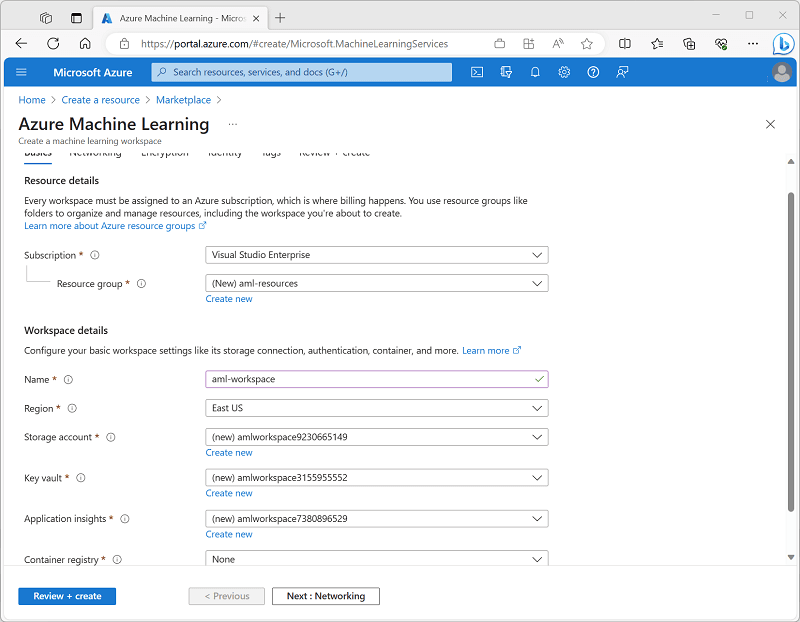
Azure Machine Learning Workspace
- Core requirement for Azure Machine Learning
- Automatically provisions supporting resources (storage, compute, etc.)
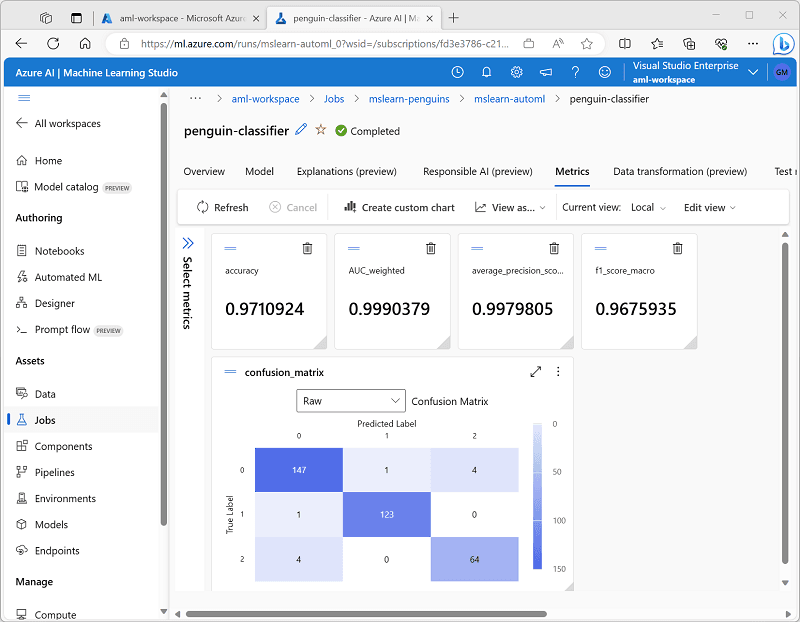
Azure Machine Learning Studio
Azure ML Studio allows you to:
- Import and explore data
- Create and manage compute resources
- Run notebooks
- Build pipelines visually
- Use automated ML
- Review trained models and metrics
- Deploy models for inference
- Manage models from the catalog
References


