
JavaScript is a single-threaded language, meaning it executes one task at a time.
This presents a major limitation when handling asynchronous tasks such as:
The event loop is a mechanism that manages the execution of asynchronous tasks (such as callbacks, promises, and async/await), ensuring they are processed in the correct order.
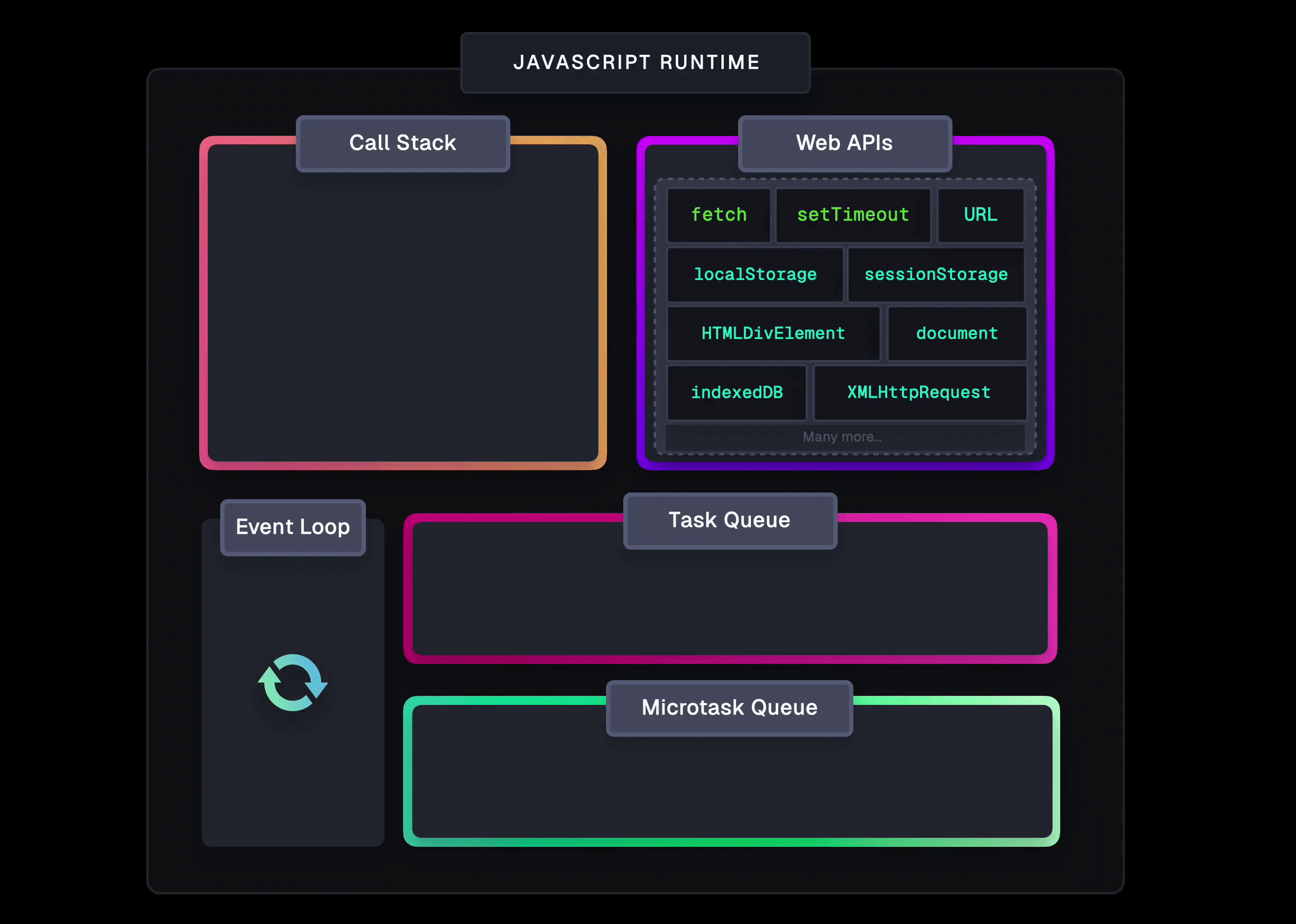
Call Stack
JavaScript uses the call stack to keep track of the functions currently being executed.
It operates on a FILO (First In, Last Out) principle.
Callback Queue (Task Queue)
Asynchronous operations such as I/O tasks or timers are handled by the browser or Node.js runtime.
Once completed, their callbacks are placed into the callback (task) queue.
Microtask Queue
A queue with higher priority than the task queue. It is used for:
then, catch, finally)async functions after the await keywordMutationObserver callbacksqueueMicrotaskThe event loop continuously checks whether the call stack is empty.
If the call stack is empty:
This ensures that asynchronous tasks are executed in the correct order without blocking the main execution thread.
"Start" is printed"End" is printed immediately"Inside setTimeout" is printedThe Event Loop ensures that JavaScript continues executing subsequent code without being blocked by the setTimeout delay.
Understanding the Event Loop, Task Queue, and Microtask Queue is essential for writing efficient asynchronous JavaScript.
The Event Loop coordinates task execution by:
This design helps JavaScript remain non-blocking while handling complex asynchronous workflows.

